
When people look at a wood-based panel production line, attention naturally goes to the large machines.
The forming machine distributes the material.
The pre-press compresses the mat.
The hot press creates the final board.
But between material forming and final pressing, there is another factor that is much less visible:
air.
A freshly formed wood-fiber or particle mat contains a significant amount of air within its loose structure. When the mat enters the pre-pressing stage, this air needs a controlled path to escape as the material is compressed.
This is where the Airing Belt becomes important.
Also known in the industry as a De-Airing Belt, Pre-Press Air Belt, Ventilation Belt or Air Venting Belt, it is designed to work together with the forming and pre-press system to facilitate air release from the mat.
Rather than viewing the Airing Belt simply as a breathable conveyor belt, it is more useful to understand it as part of the air-management system within the pre-press section.
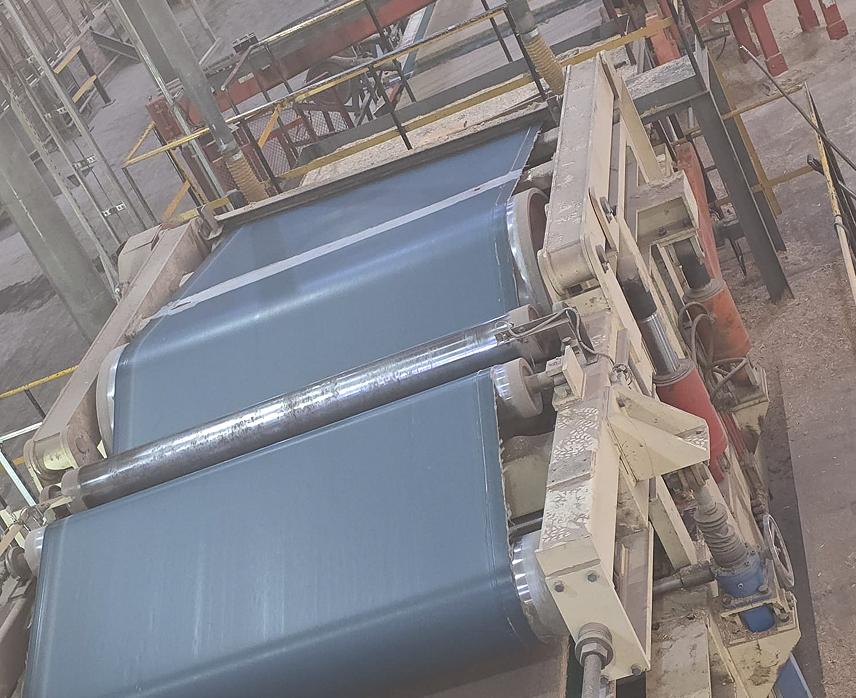
A wood-based panel mat may look like a solid layer from the outside.
Internally, however, it is still a loose structure containing particles or fibers with numerous spaces between them.
Before pressing, those spaces contain air.
As the mat becomes compressed, the internal volume decreases.
Something has to happen to the air displaced from those spaces.
If the air cannot escape efficiently, the compression process becomes more difficult to control.
The purpose of the Airing Belt is therefore connected to a very basic but important principle:
As the mat is compressed, displaced air needs a route out.
This makes air permeability a functional requirement rather than simply a material characteristic.
The Airing Belt does not work independently.
In a typical wood-panel pre-pressing process, the fragile mat passes between a forming belt and a de-airing or airing belt while compression is applied.
The Airing Belt provides a permeable path that allows air to move through the belt structure as the mat is compacted. Industry belting references specifically describe de-airing belts as part of the pre-press process and note that their function is to help press air out of the fiber mat.
The process can be simplified as:
Loose Mat → Initial Compression → Air Displacement → Airflow Through Belt → Further Compression → Pre-Pressed Mat
The belt therefore participates in the physical conditions under which the mat is compressed.
This is where Airing Belt selection becomes more interesting.
It may seem logical that the highest possible air permeability should always produce the best result.
In practice, a production belt has to balance several properties.
The belt must allow air to move through its structure while also maintaining:
Industry product specifications for wood-panel de-airing belts, for example, distinguish between air permeability, tensile properties, flexibility, temperature range and tracking-related performance rather than treating permeability as the only parameter.
The real objective is therefore not:
Maximum air permeability
but rather:
Suitable and balanced airflow performance under actual production conditions.
Another important point is that the belt must not only permit airflow; it should provide a reasonably consistent airflow path across the working area.
Imagine a belt where some regions permit significantly different airflow from others.
The air-release behavior through the mat can become less uniform.
For a continuous production process, consistency is usually more valuable than a single impressive laboratory number.
A well-designed Airing Belt should therefore maintain stable characteristics across its working width and throughout its service period.
This is one reason belt construction, yarn arrangement and manufacturing consistency matter.
Before entering the main press, the wood-fiber or particle mat is still mechanically fragile.
The material has not yet been consolidated into a finished board.
This creates a difficult operating requirement for the belt system.
The belt needs to provide enough mechanical support for continuous movement while allowing the mat to be compressed and de-aired.
The combination can be summarized as:
Support the Mat + Allow Air to Escape + Maintain Controlled Movement
A belt that performs well in one of these areas but poorly in another may not deliver a reliable overall result.
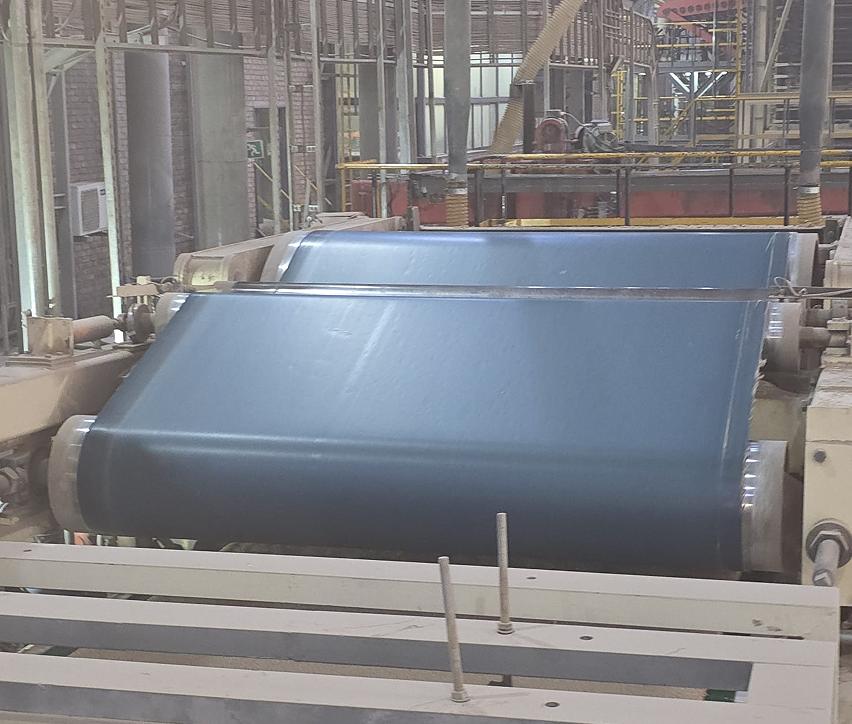
The belt structure is important, but so is the surface that contacts the material.
Wood fibers and particles can be influenced by static electricity, adhesive residues and fine dust.
When material begins to accumulate on the belt, the open structure responsible for airflow may gradually become less effective.
This means an Airing Belt should not be evaluated only when it is new.
Its performance needs to remain stable during actual production.
A clean, appropriately structured working surface can help maintain the intended interaction between:
Mat + Belt + Airflow + Compression
Dry wood fibers and particles can generate static electricity during handling.
This can contribute to particle adhesion and material buildup.
In wood-panel applications, anti-static characteristics are therefore often incorporated into ventilation or de-airing belt designs. Some industry products use conductive yarn arrangements specifically to help control static-related material accumulation.
The reason is straightforward:
Static accumulation can become an airflow problem when material begins blocking the belt structure.
So anti-static performance should not be viewed as a completely separate feature from ventilation.
The two can be closely related in practical operation.
Airing Belt performance can deteriorate gradually.
Material deposits may accumulate.
Fine fibers may enter openings in the belt structure.
Adhesive contamination may increase.
The available airflow path can then become less effective.
This creates a useful maintenance principle:
Airing performance is not only determined by the original belt design; it is also influenced by how well the belt preserves its open structure during operation.
This is why inspection and cleaning can be just as important as initial product selection.
A conventional conveyor belt is normally designed around material transport.
The key questions are usually:
Can it carry the load?
Can it run at the required speed?
Can it track correctly?
An Airing Belt has an additional functional requirement:
Can air pass through it in a controlled and reliable way while it is operating under compression conditions?
That changes the engineering priorities.
| Standard Conveyor Belt | Airing Belt |
|---|---|
| Main focus: conveying | Main focus: conveying + airflow |
| Usually solid or low-permeability structure | Open, air-permeable structure |
| Material transport | Mat support and air release |
| Surface durability | Air permeability + mechanical durability |
| General conveying applications | Pre-press and de-airing applications |
This difference is why replacing an Airing Belt with an ordinary industrial belt is generally not an equivalent substitution.
Air permeability is influenced by the physical structure of the belt.
Important factors can include:
Manufacturers of wood-industry ventilation belts use different textile constructions to achieve specific combinations of permeability, strength, flexibility and anti-static behavior.
This means two belts that appear visually similar may still behave differently in production.
One area that is sometimes underestimated is the belt joint.
The belt may have excellent permeability across its main body, but the splice can create a different mechanical and airflow condition.
For this reason, the joint needs to be considered together with:
Wood-panel de-airing belt solutions commonly use different endless or seamed constructions depending on machine configuration.
The seam should therefore be treated as part of the belt design rather than an afterthought.
Pre-press and forming systems can include relatively small-diameter rollers or pulleys.
This creates repeated bending of the belt.
A suitable Airing Belt must therefore balance:
Air permeability + Flexibility + Mechanical strength
A belt that provides good airflow but cannot tolerate the required bending conditions will not deliver good long-term service.
This is why pulley diameter should be considered during belt selection.
The basic need for air release exists across several wood-based panel applications, but the actual conditions can vary.
Fine wood fibers create a different flow and accumulation environment compared with larger particles.
Particle size and resin-coated material can influence belt interaction.
Longer strands create different mat structure and handling behavior.
As a result, one Airing Belt construction may not be ideal for every production line.
The belt should be selected according to the material, equipment and operating conditions.
One of the most important lessons is that airflow cannot be separated completely from mechanical operation.
A problem that looks like a belt problem may actually involve:
For this reason, Airing Belt troubleshooting should look at the complete pre-press environment.
The belt is one part of the system.
Operators can look for several practical signs:
The belt structure appears increasingly blocked by fibers or material deposits.
More particles remain attached to the belt surface.
The belt no longer follows its normal path.
Wear or mechanical damage changes the working structure.
The joint becomes rough, damaged or mechanically unstable.
The pre-press section may require more frequent adjustment than before.
These signs do not automatically indicate belt failure, but they are useful reasons for inspection.
A good Airing Belt should be evaluated as a complete product.
Important characteristics include:
Balanced air permeability
The belt should provide the airflow characteristics required for the application.
Stable mechanical strength
It must withstand continuous operating tension and handling.
Good flexibility
The belt needs to follow the machine geometry without excessive stress.
Reliable tracking
Stable running is essential for continuous production.
Appropriate surface properties
The material should interact properly with the mat and resist unnecessary buildup.
Anti-static performance
Where required, conductivity can help reduce static-related material accumulation.
Suitable joint construction
The splice must match the belt and machine requirements.
Rather than asking only:
“What size Airing Belt do we need?”
A more useful technical approach is to collect:
For replacement projects, photographs, technical drawings and the original belt specification can also help reduce the risk of selecting an unsuitable construction.
The maintenance goal for an Airing Belt is slightly different from that of a conventional conveyor belt.
It is not enough to ask:
“Is the belt still moving?”
The better question is:
“Is the belt still providing the intended airflow and mechanical performance?”
Routine inspection should therefore include:
This broader inspection approach can help identify performance degradation earlier.
The Airing Belt is only one component within the production line, but its condition can influence how smoothly the pre-press section operates.
A belt that maintains its functional structure can support:
Consistent Air Release → More Predictable Compression → More Stable Pre-Press Operation
A belt with increasing blockage or unstable running can create additional maintenance and adjustment requirements.
Therefore, belt quality should be evaluated not only by purchase price but also by:
service life + maintenance requirements + production reliability.
HUATAO provides Airing Belts and related industrial belts for wood-based panel production applications.
Our product solutions can be used in equipment associated with:
The product can be selected according to actual production requirements, including:
Machine configuration
Belt dimensions
Air permeability
Mechanical strength
Flexibility
Anti-static requirements
Joint structure
HUATAO focuses on matching the belt to the actual operating environment rather than treating Airing Belt selection as a simple dimensional replacement.
An Airing Belt may look like a simple mesh conveyor, but its role is more specialized.
It operates at the point where a fragile wood-based panel mat is being compressed and where displaced air needs a controlled path to escape.
That makes the belt part of the air-management and mechanical-support system of the pre-press section.
The best Airing Belt is therefore not necessarily the belt with the highest airflow number or the lowest purchase cost.
It is the belt that provides the right combination of:
Controlled Air Permeability
Mechanical Strength
Flexibility
Dimensional Stability
Tracking Performance
Anti-Static Properties
Suitable Surface Characteristics
Reliable Joint Construction
For MDF, HDF, Particle Board and OSB production, choosing the correct Airing Belt can help create a more stable interface between mat compression and air release.
That is the real reason this seemingly simple belt deserves engineering attention.
HUATAO Wood-Based Panel Machinery
Email: bella@huataogroup.com
Tel: +86 17731169773
Website: www.woodpanelmachinery.com
HUATAO provides Airing Belts, De-Airing Belts, Pre-Press Belts, Forming Belts, Metering Belts and other industrial conveying solutions for MDF, HDF, Particle Board, OSB and FOSB production lines.
#AiringBelt #AiringBeltForMDF #AiringBeltForParticleBoard #AiringBeltForOSB #DeAiringBelt #DeairingBelt #PrePressAirBelt #VentilationBelt #AirVentingBelt #AirPermeableBelt #PrePressBelt #MDFProduction #ParticleBoardProduction #OSBProduction #WoodBasedPanel #WoodBasedPanelMachinery #MatDeAiring #MatForming #IndustrialBelt #HUATAO
can not be empty
can not be empty

HUATAO WOOD PROCESSING BELT Co., Ltd
ADD : No.298 Zhonghua North Street, Shijiazhuang 050000 China.
TEL : +86 0311 80690567
EMAIL :bella@huataogroup.com
Web: www.huataobelt.com
 WhatsApp & WeChat : +86 17731169773