
In a wood-based panel production line, material does not simply move from one machine to another.
Wood particles, fibers, chips and strands need to be supplied to each process at a controlled and consistent rate.
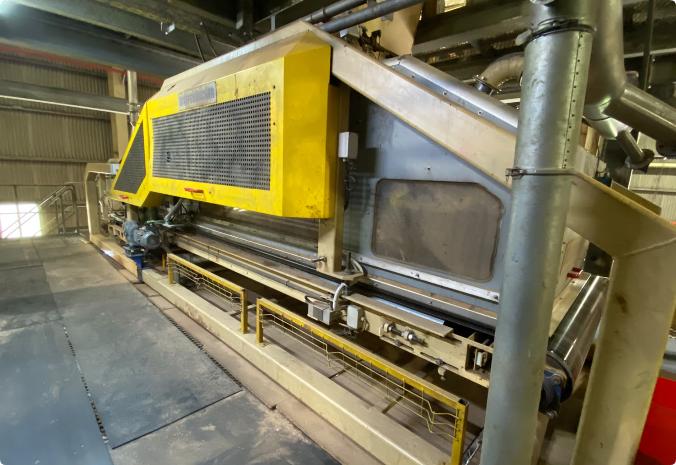
This is especially important when material is stored inside a Particle Belt Scale and needs to be discharged continuously.
At the bottom of the Particle Belt Scale, the PB Belt performs this important task.
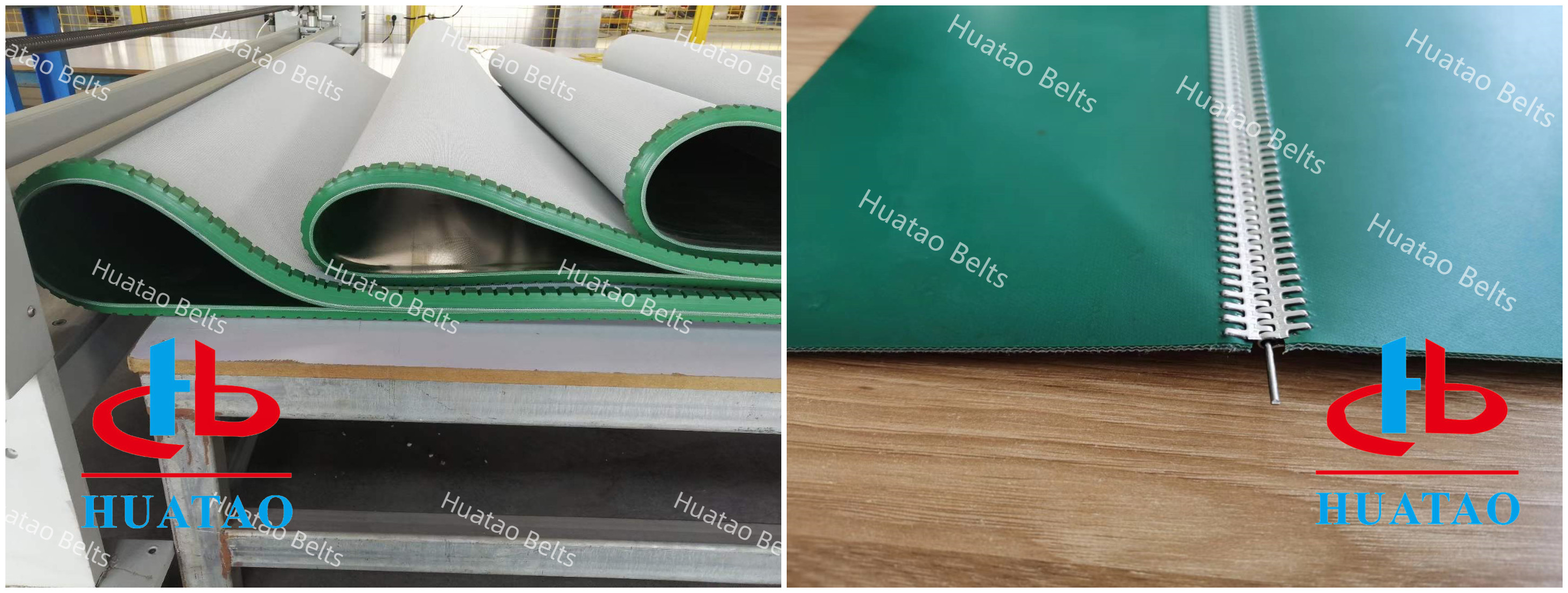
The PB Belt is the metering belt that receives material from the storage section, carries it toward the outlet and supports stable material discharge.
Although it looks similar to an industrial conveyor belt, its application is more specialized because it needs to work as part of a controlled material-feeding system.

A PB Belt is a metering belt designed for installation in a Particle Belt Scale.
Its main function is to move stored material from the bottom of the system toward the discharge point at a controlled rate.
Depending on the application, the material may include:
The belt therefore forms the moving part of the material-metering process.
The basic relationship is:
Particle Belt Scale = Storage and Metering Equipment
PB Belt = Metering Belt Inside the Equipment
This distinction is important when selecting, replacing or specifying the product.
The performance of a Particle Belt Scale depends not only on the bin itself.
The material has to move smoothly and consistently toward the outlet.
That is where the PB Belt becomes critical.
A properly selected PB Belt can help provide:
Continuous discharge
Stable material movement
Reliable feeding
Consistent belt running
Reduced material accumulation
The belt therefore acts as the direct connection between the stored material and the downstream production process.
One of the most common misunderstandings is to treat a metering belt as an ordinary conveyor belt.
A conventional conveyor belt is mainly selected according to load capacity, conveying speed, abrasion resistance and service life.
A PB Belt has additional requirements because it works inside a metering system.
It may need to provide:
The belt therefore needs to be selected according to the metering application, not simply according to general conveyor standards.
The operating principle is simple but important.
Material is stored above the PB Belt inside the Particle Belt Scale.
As the belt moves, material is carried from the bottom of the storage area toward the discharge point.
The belt speed and material conditions determine how quickly the material leaves the system.
A simplified process is:
Material Storage
↓
PB Belt Receives Material
↓
Metering Belt Moves Material
↓
Controlled Discharge
↓
Downstream Production Process
The Particle Belt Scale provides the surrounding storage and metering structure, while the PB Belt performs the actual material-carrying function.
A Particle Belt Scale may contain a large quantity of stored material.
The pressure and weight of this material are continuously transferred toward the belt.
The PB Belt therefore operates under a demanding condition.
It needs to maintain stable movement while handling:
A belt that is not suitable for these conditions may experience tracking problems, deformation or excessive wear.
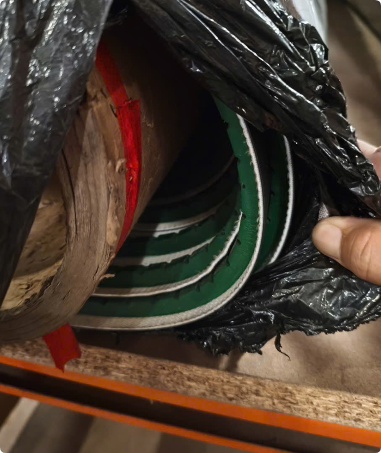
For a PB Belt, thickness is more than a simple dimensional specification.
It can influence:
The correct thickness needs to match the machine structure and operating conditions.
A belt that is too stiff may perform poorly around small-diameter pulleys.
A belt that is too light or dimensionally unstable may be more difficult to control during continuous operation.
The correct choice is therefore a balance between strength, flexibility and machine compatibility.
A PB Belt needs to remain stable across its width.
Excessive lateral movement can affect belt tracking and create additional adjustment requirements.
Good lateral stiffness can help the belt maintain its intended running position.
This becomes especially important when the belt is operating continuously below a material storage system.
Stable tracking contributes to:
Wood fibers and particles do not always release completely from a belt after passing through the discharge area.
Material that remains attached to the working surface can gradually accumulate.
This may result in:
A suitable PB Belt should therefore provide appropriate surface characteristics for the material being handled.
Good release performance can help maintain a cleaner working surface during long-term operation.
Dry wood materials can generate static electricity during handling.
For a metering belt used with fine fibers or particles, static can encourage small particles to adhere to the belt surface.
Over time, this may increase material buildup.
Depending on the application, anti-static belt construction can help reduce this effect.
The practical goal is:
Lower static accumulation → Less material adhesion → Cleaner belt surface → More stable operation
The appropriate anti-static design should be selected according to the actual material and production environment.
MDF and HDF production commonly involves fine wood fibers.
These materials have different flow characteristics from larger wood chips or particles.
They may be lightweight and more affected by static electricity.
For this reason, PB Belts used for fiber metering should provide suitable:
The belt needs to work reliably while continuously carrying lightweight fiber material from the Particle Belt Scale.
Particle Board production involves wood particles with different sizes and shapes.
The belt surface must be suitable for the material while maintaining stable operation under continuous loading.
The PB Belt can be used beneath Particle Belt Scale systems to provide controlled discharge of particles toward subsequent processes.
Depending on the line configuration, this can support material feeding toward:
OSB and FOSB use wood strands that are generally larger and more elongated than MDF fibers.
The material may therefore create different mechanical conditions at the belt surface.
The PB Belt needs to be selected according to:
The objective remains the same:
Stable discharge and reliable continuous material feeding.
A metering system is only useful when material can be discharged consistently.
If the belt speed changes unexpectedly, tracking becomes unstable or material accumulates on the surface, the discharge process may also become less consistent.
This is why the belt's mechanical characteristics matter.
A stable PB Belt helps create a more predictable transition:
Stored Material → Metering Belt → Controlled Discharge → Downstream Process
This is particularly important for continuously operating production lines.
Several issues may appear during long-term operation.
The belt moves toward one side of the machine.
The working surface gradually deteriorates because of continuous material contact.
Fibers or particles remain attached to the surface.
Long-term operation can change belt tension and running characteristics.
The splice can become a weak point under continuous mechanical loading.
Abrasive material or foreign objects may damage the belt.
These problems should be addressed before they affect the overall material-discharge process.
Routine maintenance should focus on both the belt and the surrounding equipment.
Recommended checks include:
Regular removal of accumulated material can help maintain stable belt operation.
Maintenance intervals should be adjusted according to the material type, throughput and working hours.
Selecting a PB Belt should start with the existing Particle Belt Scale.
Important technical information includes:
The machine structure determines the required belt specification.
Must match the original equipment.
Needs to correspond to the actual belt path.
Should match the mechanical and operating requirements.
Important for belt flexibility and bending performance.
The belt must be suitable for the required running speed.
Fiber, particle, chip and strand applications may require different belt characteristics.
The belt construction should match the installation and maintenance conditions.
A PB Belt may appear to be a simple replaceable component.
However, correct selection requires more than matching length and width.
The final compatibility depends on:
PB Belt + Particle Belt Scale + Material + Pulley System + Operating Conditions
A technically suitable belt should work correctly with the entire system.
For replacement projects, original drawings, existing samples, machine models and detailed dimensions can help improve specification accuracy.
Different Particle Belt Scale systems may have different:
For non-standard equipment, a customized PB Belt can provide better compatibility than a general-purpose belt.
HUATAO can manufacture PB Belts according to:
The belt can be selected according to the actual material and working conditions.
HUATAO provides PB Belts / Metering Belts for Particle Belt Scale applications in wood-based panel production.
Our application range includes:
The product selection can take into account:
Belt Width
Belt Thickness
Belt Length
Pulley Diameter
Operating Speed
Material Characteristics
Surface Requirements
Anti-Static Requirements
Joint Construction
The focus is to provide a PB Belt that matches the actual Particle Belt Scale rather than treating the belt as a generic conveyor product.
The Particle Belt Scale provides the storage and metering structure.
The PB Belt provides the actual material-carrying surface at the bottom of that system.
This creates a simple but important production relationship:
Particle Belt Scale → PB Belt → Material Discharge → Downstream Process
When the PB Belt maintains reliable tracking, suitable surface performance and stable mechanical properties, it can support a more consistent material-discharge process.
That is why the PB Belt deserves to be selected as an application-specific component.
The PB Belt is the specialized metering belt installed in a Particle Belt Scale for controlled discharge and continuous feeding of wood-based materials.
Its role is more demanding than that of a standard conveyor belt because it must combine:
Stable Conveying
Reliable Material Discharge
Dimensional Stability
Good Tracking
Suitable Flexibility
Material Release
Anti-Static Performance
Durable Joint Construction
For MDF, HDF, Particle Board, OSB and FOSB production lines, choosing the correct PB Belt can contribute to more stable material feeding and reliable operation of the Particle Belt Scale.
The right approach is to select the belt according to the machine, material and working conditions, rather than choosing a belt only by size.
HUATAO Wood-Based Panel Machinery
Email: bella@huataogroup.com
Tel: +86 17731169773
Website: www.woodpanelmachinery.com
HUATAO provides PB Belts, Metering Belts and other conveying solutions for Particle Belt Scale systems used in Particle Board, MDF, HDF, OSB and FOSB production lines.
#PBBelt #PBMeteringBelt #MeteringBelt #ParticleMeteringBelt #ParticleBelt #BeltForParticleBeltScale #ParticleBeltScaleBelt #DosingBelt #BinBottomBelt #MaterialMeteringBelt #MDF #HDF #ParticleBoard #OSB #FOSB #WoodBasedPanel #ParticleBoardProductionLine #MeteringSystem #WoodBasedPanelMachinery #HUATAO
can not be empty
can not be empty

HUATAO WOOD PROCESSING BELT Co., Ltd
ADD : No.298 Zhonghua North Street, Shijiazhuang 050000 China.
TEL : +86 0311 80690567
EMAIL :bella@huataogroup.com
Web: www.huataobelt.com
 WhatsApp & WeChat : +86 17731169773