
A ventilation belt is an important component in the pre-compression section of wood-based panel production.
During operation, the loose fiber or particle mat is transported while air is extracted through the belt. The belt therefore needs to provide suitable air permeability, a smooth working surface and reliable running performance.
However, one detail is sometimes overlooked during replacement: the belt joint.
For MDF applications, a conventional steel clip fastener may not be the most suitable connection method.
Ventilation belts are used in the mat pre-compression process of MDF and particleboard manufacturing.
Their main functions include:
Air permeability and surface smoothness are important characteristics for this application. The belt must also maintain stable operation under the actual machine tension and running conditions.
Steel clip fasteners are widely used in some conventional conveyor belt applications because they allow relatively convenient installation and mechanical connection.
However, MDF ventilation belts have different operating requirements.
A steel fastener may create a raised connection area compared with the surrounding textile belt surface.
This can introduce several potential concerns.
During pre-compression, the belt runs in contact with the loose mat.
If the joint has a noticeable height difference or uneven profile, it may create periodic contact marks on the material.
Whether such marks appear depends on the machine configuration, belt position, mat condition and joint geometry.
A mechanical fastener may produce a thicker section at the joint.
This difference can affect how the belt passes around rollers and interacts with supporting components.
A relatively uniform joint profile is therefore preferable where the equipment requires a smooth running surface.
If fasteners become loose, damaged or protrude beyond the intended profile, they may interfere with machine components.
This is particularly important in equipment with limited clearance.
A mechanical joint introduces additional components that need to be checked.
The condition of the fasteners, connection points and surrounding belt material should be inspected regularly.
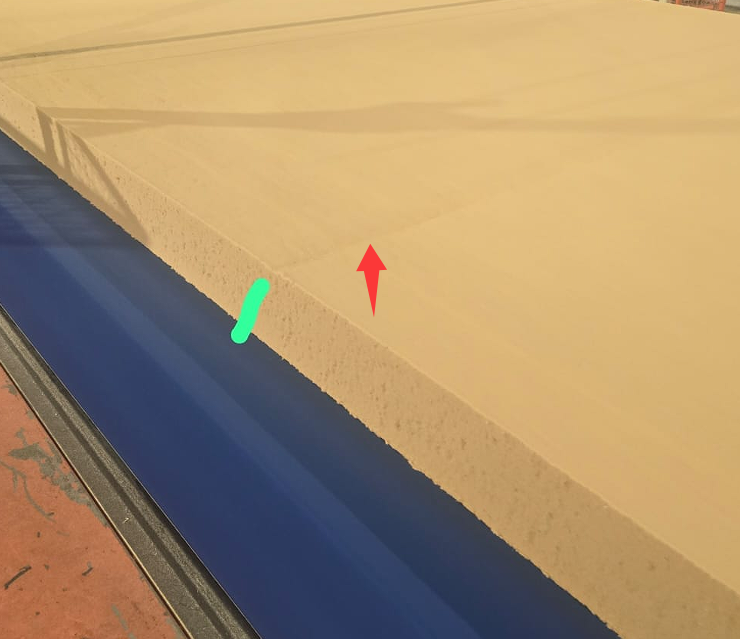
The connection method should be selected according to the belt construction and equipment requirements.
| Joint type | Main characteristics | Considerations |
| Z-splice | Textile splice with a relatively smooth profile | Requires accurate manufacturing and installation |
| Endless construction | Continuous belt construction without a conventional clip joint | Installation and machine assembly must be considered |
| Spiral ring joint | Mechanical loop connection | Suitable only for compatible belt structures |
| Pin ring joint | Mechanical connection that can be opened for installation | Joint profile and machine clearance must be checked |
| Steel clip fastener | Convenient mechanical connection | May create a raised section and additional contact points |
No single connection method is suitable for every ventilation belt.
For MDF mat-contact applications, a low-profile connection is worth considering when surface marking and smooth running are important.
Before selecting a replacement ventilation belt, evaluate:
Machine configuration: Roller diameter, support arrangement and available clearance.
Belt properties: Thickness, air permeability, tensile strength and flexibility.
Joint requirements: Connection profile, strength and installation method.
Operating conditions: Running speed, belt tension, material contact and cleaning requirements.
Maintenance arrangements: Whether the belt needs to be installed without dismantling major machine components.
The equipment manufacturer's specifications should take priority when confirming the joint type.
Explore related belt solutions for wood-based panel production:
These products serve different applications and should be selected according to their respective operating requirements.
If you are planning to replace an existing ventilation belt, please provide:
With this information, the belt construction and connection method can be evaluated more accurately.
A ventilation belt joint is not merely a connection detail.
In MDF production, the joint profile can influence surface contact, running clearance and maintenance requirements.
Steel clip fasteners may be convenient in some applications, but where a smooth, low-profile working surface is required, alternative splice designs deserve consideration.
Choosing the right ventilation belt means considering the belt structure and its joint together.
can not be empty
can not be empty

HUATAO WOOD PROCESSING BELT Co., Ltd
ADD : No.298 Zhonghua North Street, Shijiazhuang 050000 China.
TEL : +86 0311 80690567
EMAIL :bella@huataogroup.com
Web: www.huataobelt.com
 WhatsApp & WeChat : +86 17731169773